- META-SPIEL
- Posts
- Illinois at Cultural Night
Illinois at Cultural Night
Surrender to the culture of the Prairie State

Phil Huckelberry
March 23, 2026

Every year our school holds Cultural Night. Imagine an elementary school gym with folding tables set up around the edges, and on the tables poster board presentations of the culture of various countries: pictures of people, dances, clothing, maybe a map. And, at many of the tables, some kind of traditional food. It’s a fantastic event and one of the highlights of the school year.
Since the typical table is a family which is no more than two generations removed from another country, we’d never thought about tabling. But this time around - our last time around - I had two parallel thoughts. First, my kid has never done a project like this, something for public consumption, and it’d be good for him. And second, it might not be super exciting, but we do have a culture to share, going back as far as eight generations.
Yes, we had an Illinois table at Cultural Night.
So I want to tell you all about the table, about what we did for it, and about how ridiculous I am. Some of the pictures are from that night, some are from before and some are from after. What I really want to get across here is the idea that I’ve thought a lot about this and some of it might not be what you normally think of as “culture” but it really is who we are, where are from, and… maybe if we thought differently - expansively, creatively - about culture it would help our struggling society a whole lot.
So here’s what the table looked like:
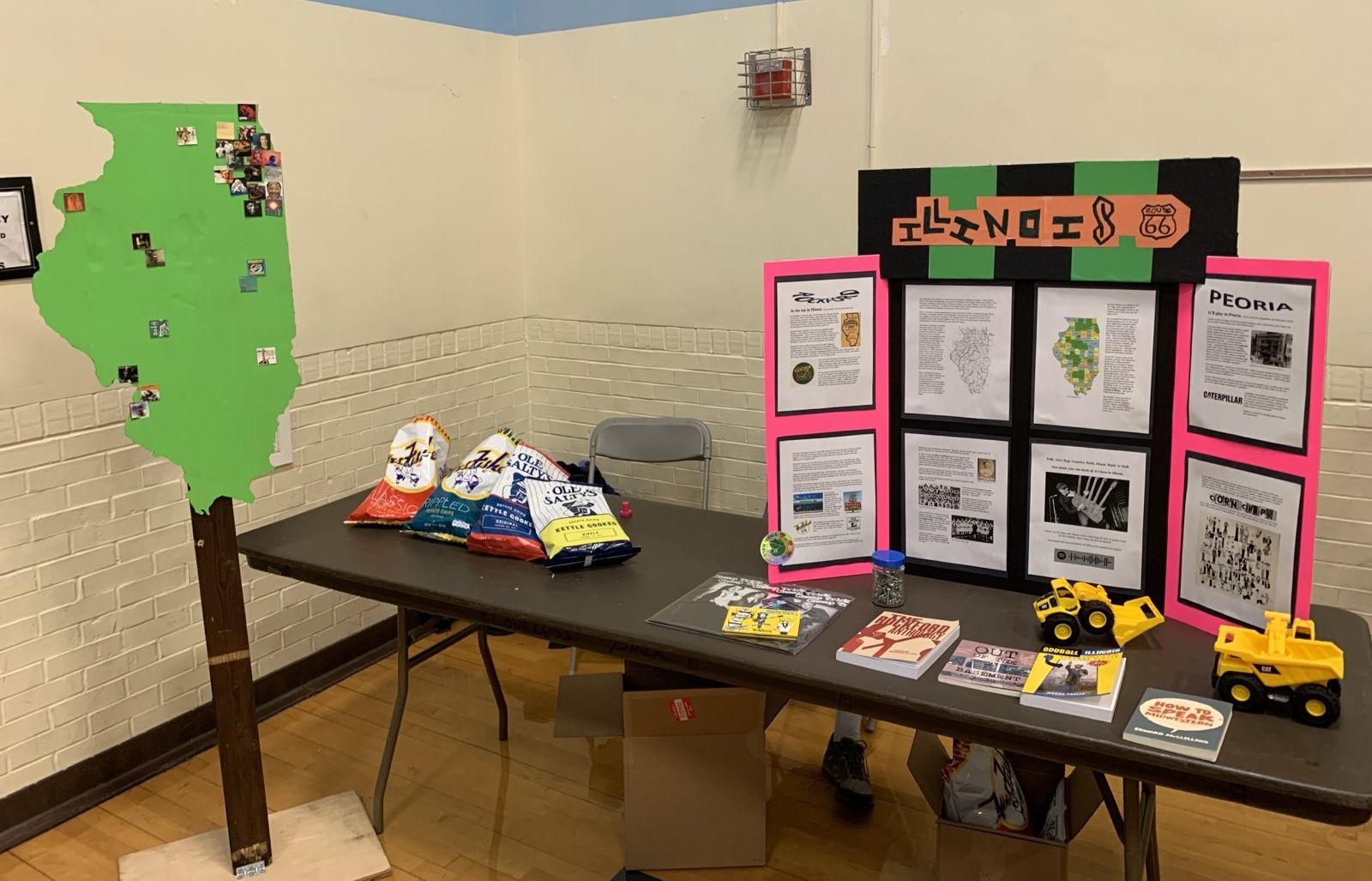
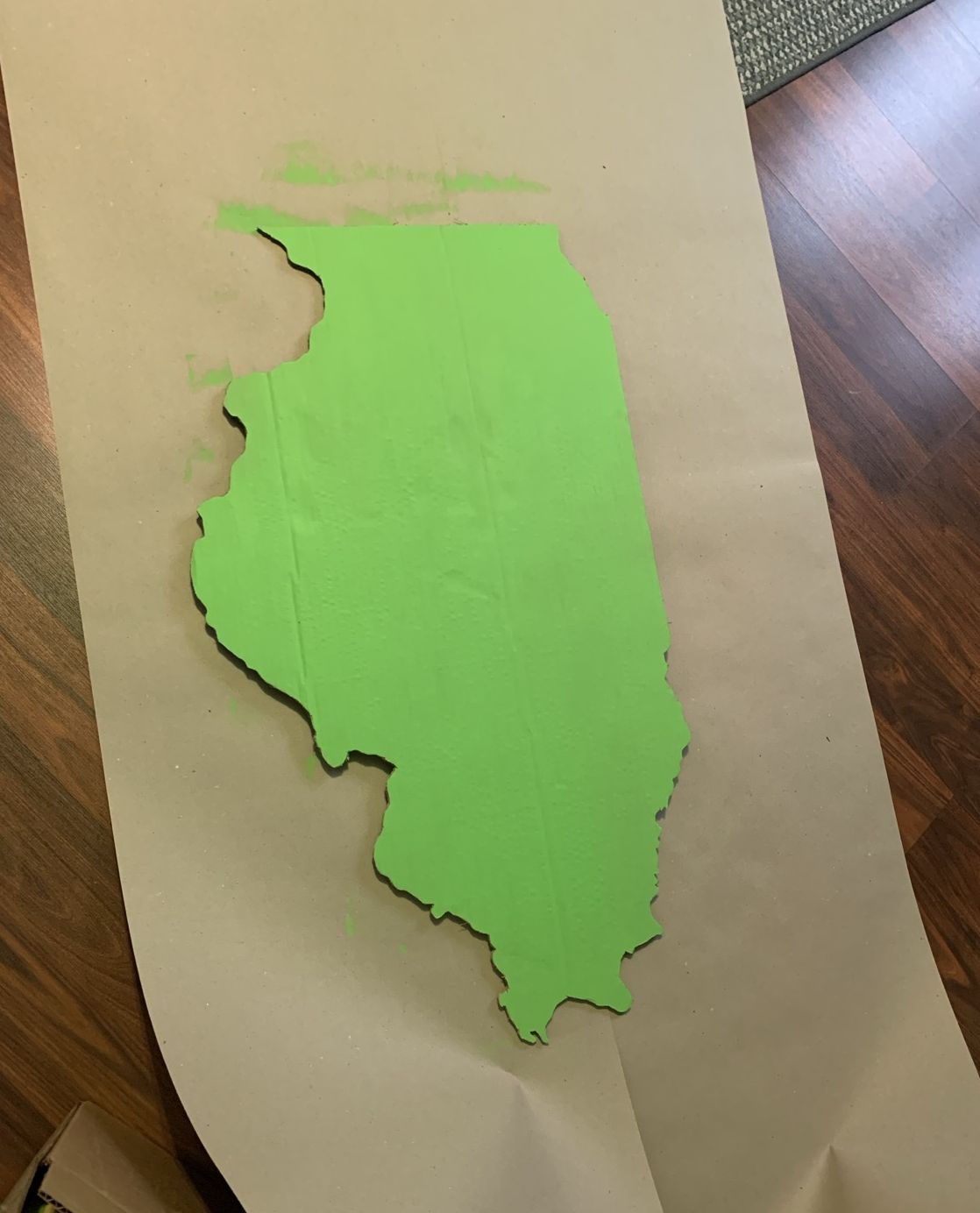
Yes, that’s a three foot tall bright green Illinois on cardboard. What you see on it is a bunch of little 1½” cutouts of album covers, representing as best as possible the parts of Illinois that the artists are associated with. I’ll have more about this below. I’ll also have more about how the Illinois cutout came to be.
On the table, closest to the cutout, are bags of potato chips. I ordered several bags of Mrs. Fisher’s and Ole Salty’s, two venerable potato chip makers from Rockford, and they were a hit, until we ran out of bowls!
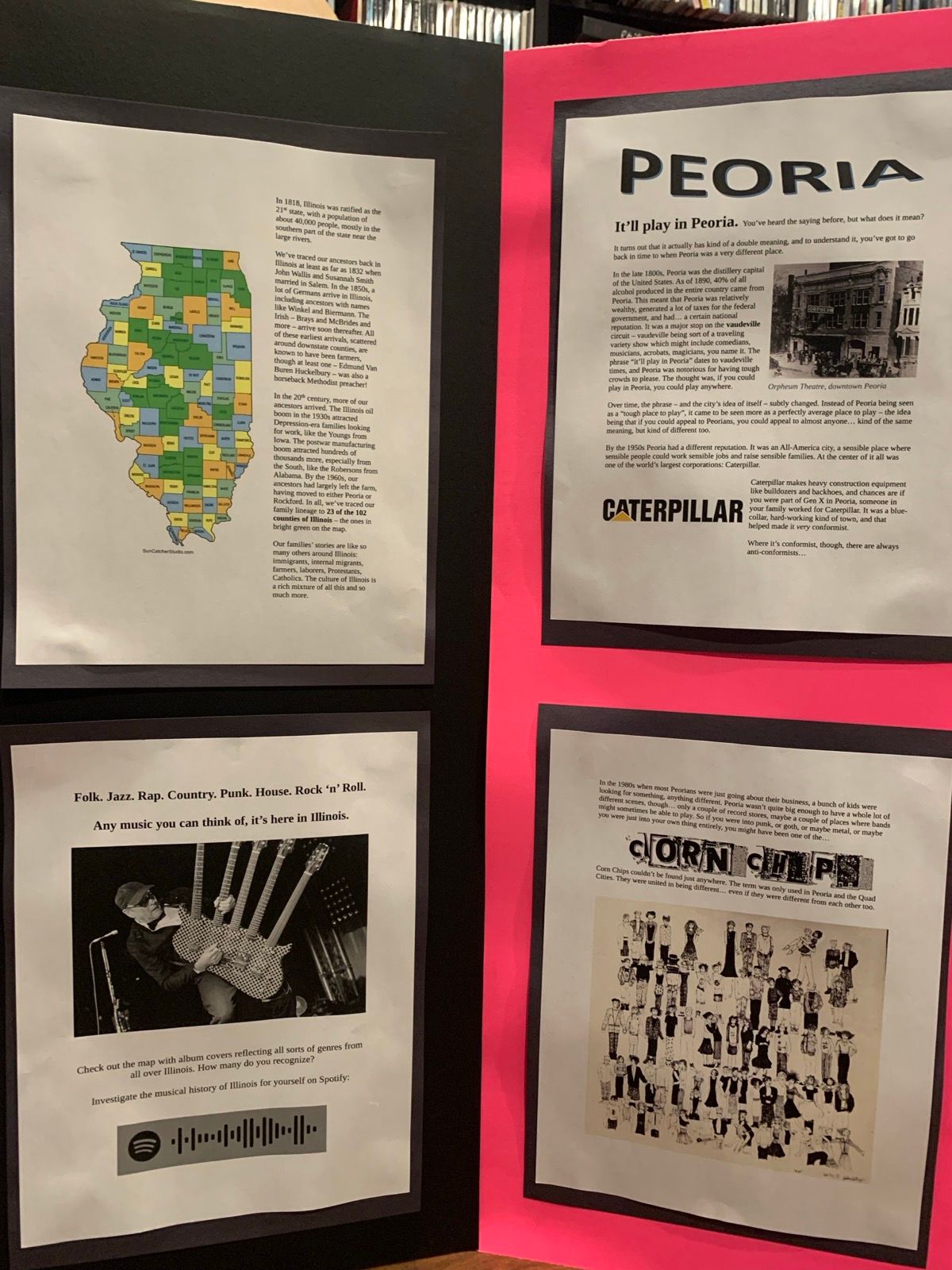
The left of the posterboard is two sheets devoted to Rockford, the right two sheets devoted to Peoria, and the middle four sheets for Illinois more generally. Here’s a close up of the content of the poster board. Special thanks goes to Jonathan Wright and Mae Gilliland Wright. The artwork of the Peoria Corn Chips is with Jonathan’s permission, and as I was doing a little research along the way, I found an article of his about Peoria from vaudeville times which was very helpful. Seriously, people, if you want to know what is up with Peoria culture, you start with them, including the terrific book Punks in Peoria co-written by Jonathan and Dawson Barrett. Thanks are also due to the Peoria Area Convention and Visitor’s Bureau for sending some stickers along.
Also on the table, from left to right:
Cheap Trick’s 1977 self-titled first album on vinyl
Cheap Trick’s 2006 album Rockford on CD
a jar full of screws and similar items to represent Screw City
The Rockford Anthology, edited by Rachel León, recently issued by Belt Publishing
Out of the Basement: From Cheap Trick to DIY Punk in Rockford, Illinois, 1973-2005, by David Ensminger
Oddball Illinois: A Guide to 450 Really Strange Places by Jerome Pohlen (fun facts: Jerry is an old acquaintance, and I found the book at the delightful store Relics in East Peoria)
How to Speak Midwestern by Edward McClelland (you really need to own this)
three toy Caterpillar construction vehicles to represent Peoria
The eight sheets of paper on the posterboard:
Left: Rockford
Mini-writeup on the city’s history
More on the city’s history with a spotlight on food
Center: Illinois
Land acknowledgement and early history of European settlers
Baseball in Illinois including the Rockford Peaches and Peoria Redwings
County map, more on this below
Rick Nielsen with a signature guitar and an explanation of the map
Right: Peoria
Mini-writeup on the city’s history
The Corn Chips!
Here are closeups of the posterboard:
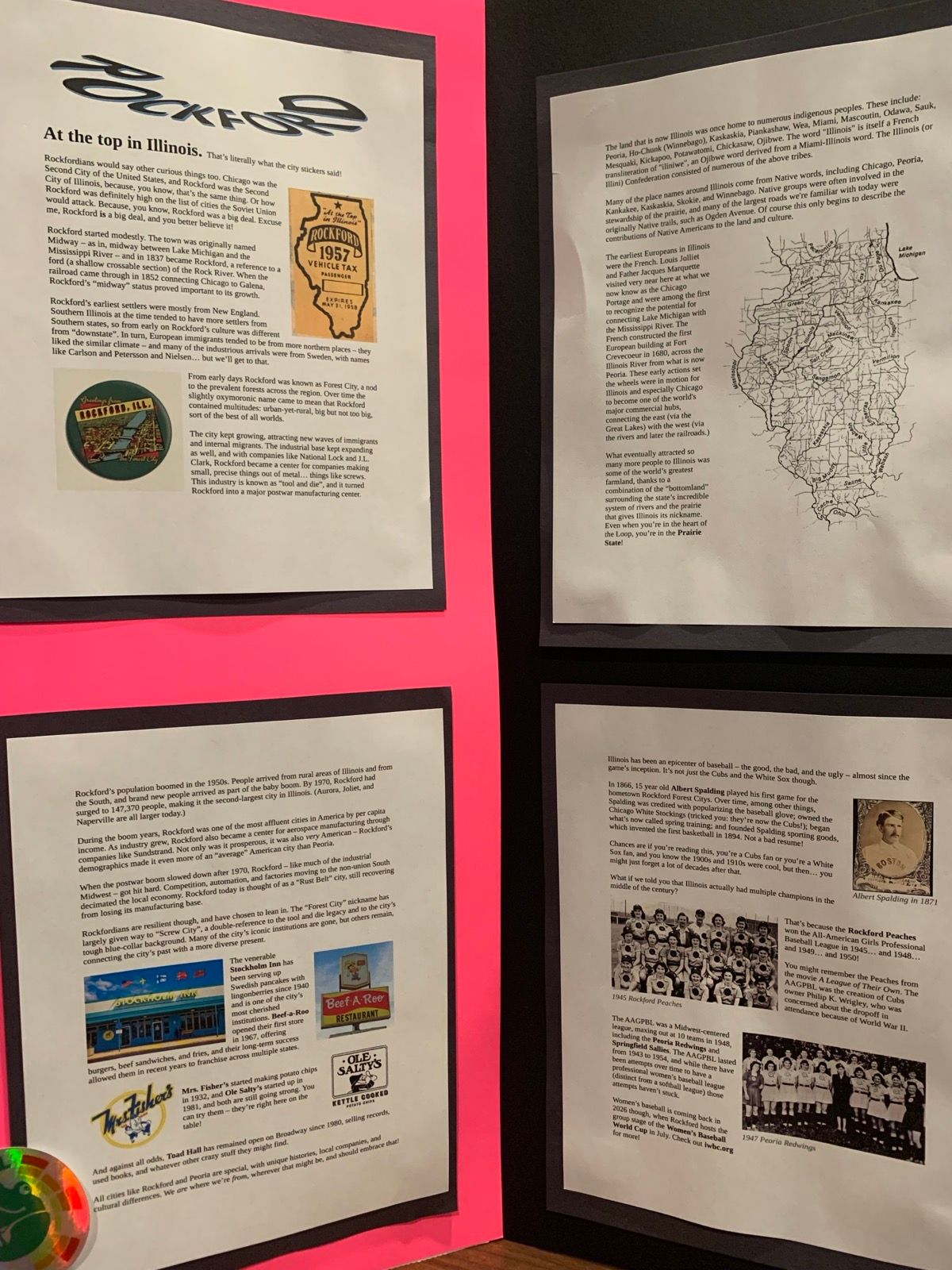
On the subject of women playing baseball in Rockford: did you know that the Women’s Baseball World Cup is coming to Rockford (well… Loves Park), this July 22-26? It’s the women’s version of the World Baseball Classic. No, you didn’t know, did you? But now you do. We plan on being there for part of it. You should too!
And I want to say, the county map was one of my favorite inclusions. The counties in green are ones to where we’ve traced direct ancestors of ours. That’s 23 of 102 counties, with the earliest known presence traced to 1832, when John Wallis and Susannah Smith married in Salem. That’s some old school Illinois credibility! Our goofball child actually represents the 9th consecutive generation to live in Illinois.
Speaking of goofball child: with this project he got sucked into a vortex of his father’s madness. His two main contributions were in helping me paint Illinois, and in creating the Illinois title. The rest of it was more or less me losing my mind over a school project.
The people who most appreciated the vortex were, unsurprisingly, people about my age, who were intrigued by the idea that there would be an Illinois table alongside tables for Lebanon, Korea, Puerto Rico, Ukraine, Mexico, Moldova, etc. We even got one excited former Rockfordian. The whole thing - save the potato chips - may have been almost totally lost on the actual kids!
Admittedly offering potato chips when other tables offered plăcintă and varenyky was unusual, but that really is our culture. This is America, ultimate land of convenience, which among other things means packaged foods, and what distinguishes one part of this wacky country from another is often subtle, but I can tell you, having gone to a rural high school, we understood that there were differences from one farm town to the next, and those differences impact the way people think. This may be less true today in such a digital, globalized world, but there’s still truth, and I think it’s something that is badly underappreciated.
A few notes here on my thinking for the table and how it came together. It could have been Illinois without the focus on Rockford and Peoria and a lot of the content would have been the same, but the idea for focusing on the cities was something I’d had for a while, serving two related purposes. One is that that really is where we come from. The other related idea is that visiting grandparents doesn’t really explain a lot to a kid about what it means for his parents to be from a place. This is especially true with Rockford, given that Grandma’s house is barely in the city limits and he simply hasn’t seen hardly any of the city.
I feel like it didn’t used to be this way. This seems impossible but I remember going to Centralia when I was young - probably the summer I was 5 - and my great-grandparents were still there, and that memory is part of a fabric of the handful of other times I’ve been there. My MA thesis is on Centralia so admittedly I know a lot more about what was going on there in the 1940s than I might know from visiting as a kid, but I think a lot of it was kind of obvious. When I visited in 1999, the place looked like it hadn’t hardly changed since the late 50s. Meanwhile, Michelle vividly remembers trips to Morrisonville from when her grandparents lived there in the 80s, complete with going to the town IGA for donuts. A kid that remembers doesn’t just remember what a place like that looked like, they remember what it felt like, and they could imagine what the people were like and had been like for a long time. I just don’t think a kid today can get that same feeling so readily in a lot of these places. (Though, maybe, when we finally take him to see Morrisonville, that’s one place which will still look mostly the same.)
Think about old pictures you’ve seen over time, about how all of the aspects change - the clothing, the hairstyles, the walls, even just the way the coloration of the photos come across. 1900 looks very different from 1920 looks very different from 1940 looks very different from 1960. But at some point the differences aren’t as pronounced. We’ve been taking high-quality digital photos for 20 years. The clothes and hair might be different but even though it sometimes seems like we’re in an absurdly fast-paced never-changing world, some changes have actually slowed down, and I think this impacts the quality of how we can talk to our kids about how things used to be.
A lot of this gets at why I think it is extremely relevant to try and impress upon kids that when they think about culture, what Rockford looked like in 1988 is a genuinely interesting and weird thing to consider, even if comparatively Kyiv in 1988 was far more different than Rockford in 1988 to Brookfield today.
As for the table itself and all of its trappings, the main thing was of course figuring out how to come up with a 3 foot tall cutout of Illinois to display, and this is how I did that:
I had some large cardboard panels around the house from some larger boxes, including a small fridge we have. I measured the largest panels available to try and figure out what would be the most proportionally useful piece.
I searched online for a very basic outline of Illinois, took the image and cleared out some text from it, and saved it as a PDF. I used the PDF program and printed at 400% scale and laid the resulting paper across the cardboard I’d selected. The size wasn’t quite right, but I found that 350% scale worked pretty well.
A basic box cutter was used to cut the panel off from the rest of the box. Then the paper with the blown-up outline of Illinois was taped down to the cardboard. (Forgive me for using passive construction in this paragraph, I was trying to avoid starting another paragraph with the word I!)
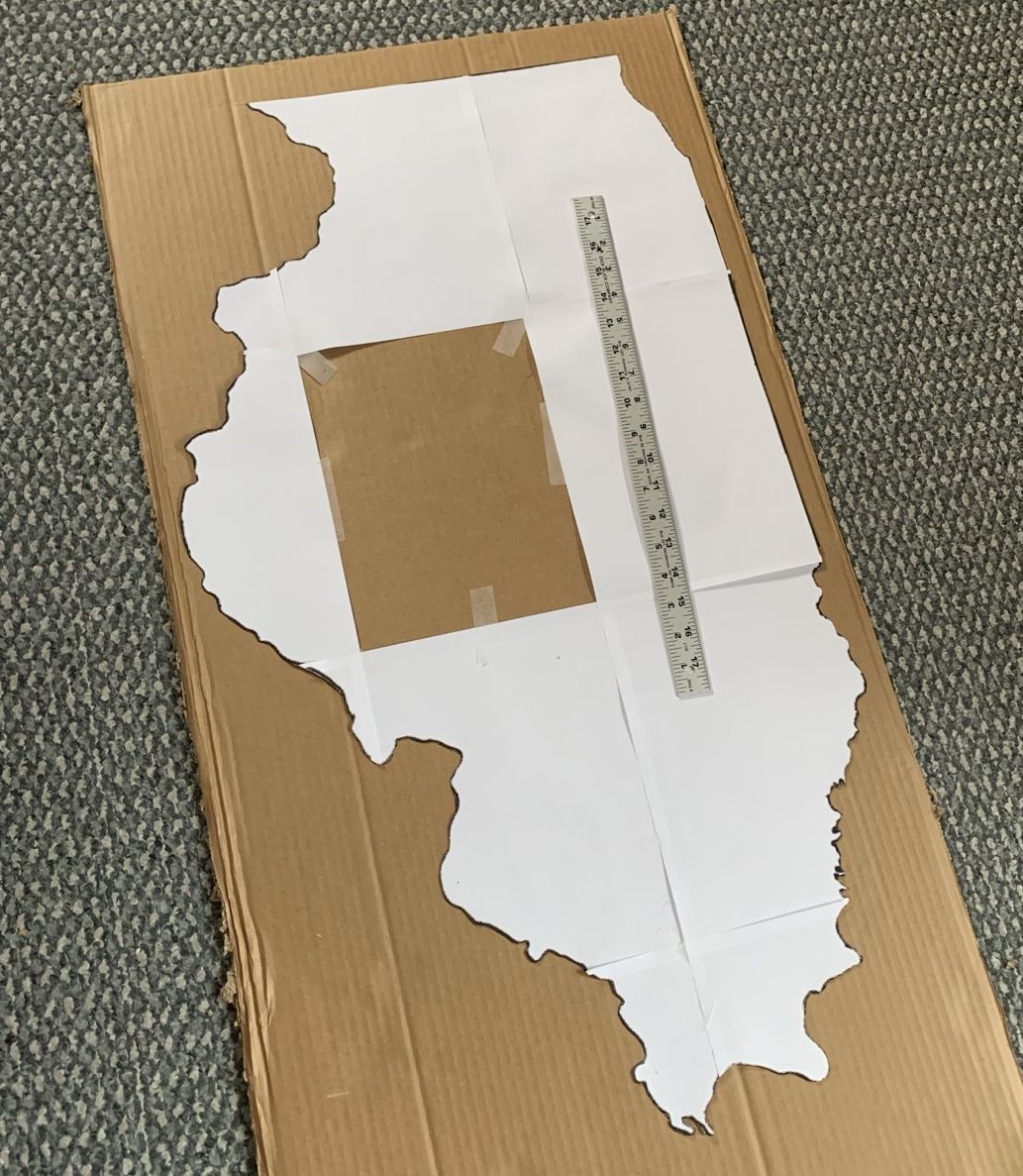
I used an X-Acto knife and for the northern and western borders which are flat, I used a half-meter ruler to make clean straight cuts. Then I slowly and shallowly carved around the outline of the rivers. Once I’d gone the entire outline, I detached all of the paper, and I was able to go back with the knife and retrace the steps, cutting all the way through. Even in some of the trickier parts (looking at you here, Wabash) I was able to keep the outline in good shape with this technique, because I had gone large enough that I could keep most of the bends well intact.
We painted with foam brushes using a lime green acrylic paint. The stand was a recovered board from our distinegrated picnic table, screwed into place using a couple of metal brackets, to an old thicker board as a base. I used a Velcro strip on the back of the map and a matching one on the board to keep it in place, which is what allowed it to be elevated and visible from across the gym.
Most of the rest of the table props came together more naturally. I did go out of way and buy the Caterpillar toy implements off of eBay and pick them up in Lombard, and I also ordered the Cheap Trick vinyl from Rockford’s legendary Toad Hall which very much still exists on Broadway. (I haven’t been there in 30 years and I’m very keen to see the place after all this time.)
Yes, I overdid it, but I think it all came off looking pretty good.
Several years ago I had an idea for a piece which I thought would work best in the Chicago Reader or Illinois Times about how Illinois is largely defined by its rivalries. When you look at surrounding states, they tend to have more of a uniform sense of themselves, and more of a consistent sense of state pride. This is certainly true in Wisconsin and Minnesota, very much true in Michigan, emphatically true in Kentucky and Tennessee, and by gum, it’s even true in Indiana.
What provides the coherence to Illinois? Well, I think the University of Illinois is less prominent in the state’s conscience than comparable institutions in states like Wisconsin, Indiana, and Kentucky. The state’s loyalties are divided in many sports - the Bears and Bulls have monopolies, but the Cubs-Sox and Cubs-Cardinals splits are arguably even more definitional, at least traditionally. And those of course mimic the north side - south side and city - downstate antagonisms.
I thought about all this while we were working on the project. I think Illinois is missing a sense of state pride that other states have. And there are a whole lot of reasons for this, reasons which date back to the inception of the state, how the southern part tended to be filled in by southerners and the northern part by New Englanders and more recently arrived northern Europeans, and how Chicago came to dominate the state over time, and all of the wild and wacky things that Illinois politics have had to offer.
I think it’s high time we reclaim a broader sense of state pride.
Over the course of working on the project, especially in compiling the core information on the poster board, what occurred to me was, there’s a book here. A book where the differences are peeled back and the commonalities are found - or maybe where the differences are recognized as the parts which add up to a greater sum. A book where every place, cosmopolitan or otherwise, plays a role, even if we decide to pronounce those places very strangely.
There’s something to be said about the idea that nine generations of my family have consistently lived in Illinois across almost two full centuries.
So, yeah, I’m seriously thinking about what this book might be, and how to go about putting it together. (And some people thought I went overboard on the Cultural Night table…) I’d love to hear your ideas about what ought to be included. I’m thinking about a summertime project of putting together an outline, and expect that I’ll be bouncing some ideas around in some upcoming Musings.
Reply